

Material Religion
Division, hate, bondage, abuse, control, and enslavement are all byproducts of material religion. Material religion, by which I mean the religion of material, is not exclusive to theism (though theistic institutions are among its most prolific expressions) but is the pervasive impulse to reduce truth to something material, or that which is controllable, certain and final. It is the dominant societal mechanism in both secular and theistic contexts, and it is upheld by certainty. If humanity is to progress with health and stability, material religion must be defined, its consequences articulated, and its influence replaced with subjective faith.
What is material religion?
Material religion intrinsically associates truth with materiality. To understand its function, it is necessary to establish what is meant by material and truth.
Material refers to anything constrained by time, condition, limitation, and change. It encompasses not only physical matter, but also mental, emotional, social, institutional, and data-based constructs; material anything that can be defined, represented, enforced, or controlled.
Truth refers to the totality of all that is real; truth is unconditional, unchanging, timeless, and whole. Truth is not partial or circumstantial; it transcends perception and is not subject to variation. Truth, by its nature, cannot be fully contained in any material expression.
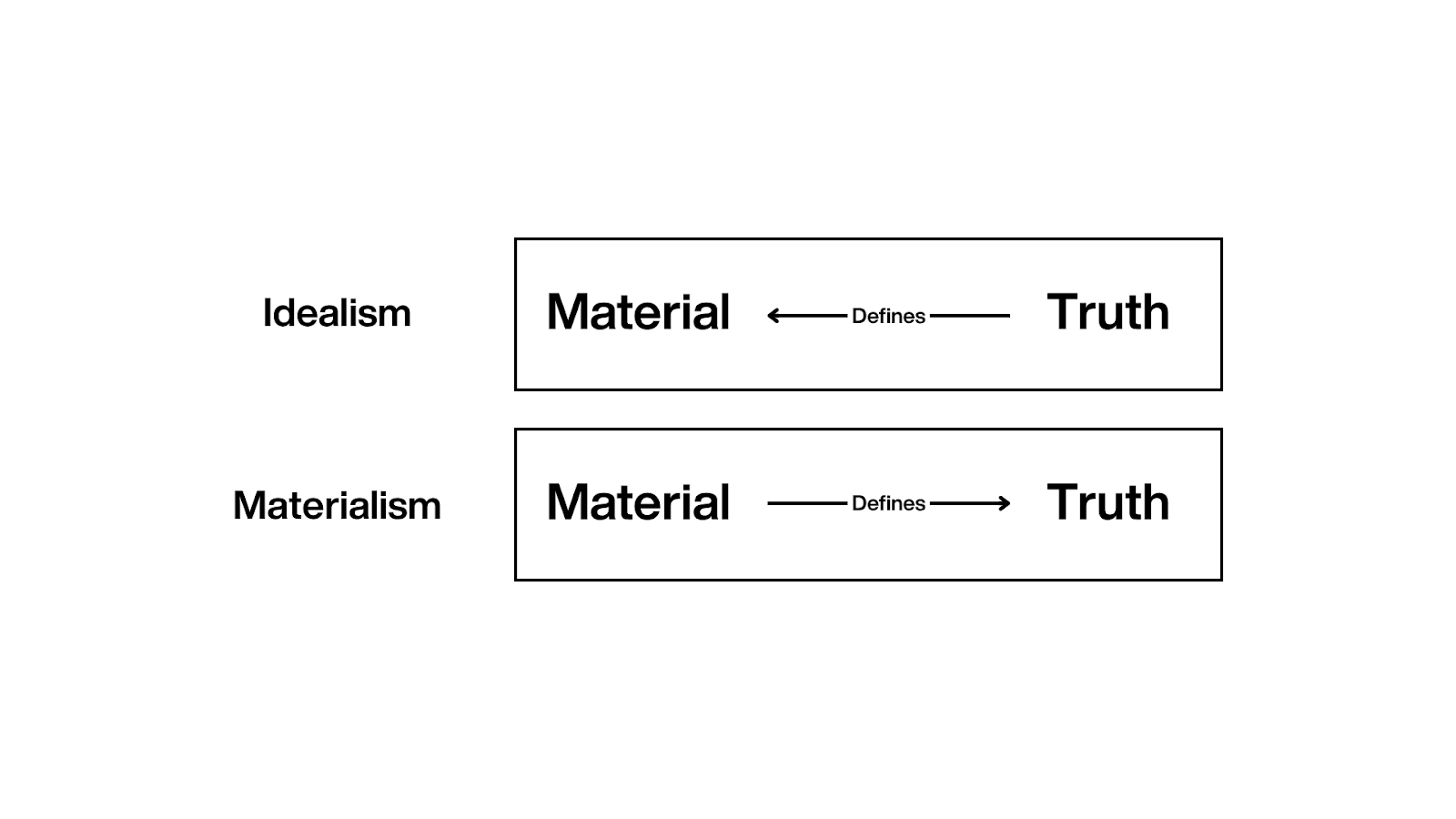
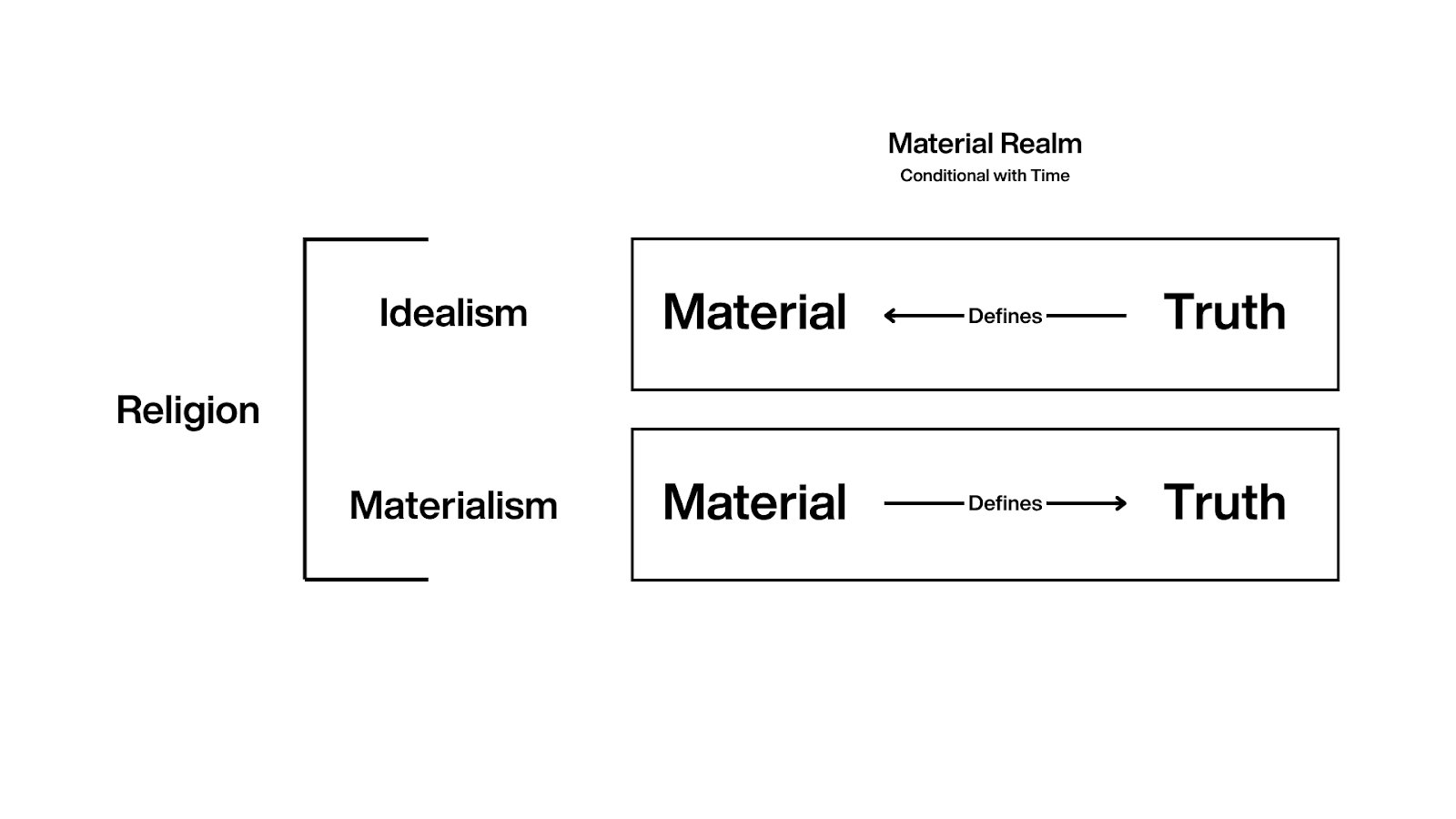
Material religion occurs when truth is directly associated with, believed to arise from, or believed to mandate material reality. This association is the foundation of both materialism and idealism, the two dominant historical frameworks of human thought.
The Two Religious Trajectories of Thought
Materialism: Truth arises from matter.
Materialists ground and derive truth from the material world – what is observable, measurable and controllable. At the height of technological advancement, “material” includes atoms, doctrines, rituals, identities, emotions, institutions and data. These are treated as the basis of truth; they are defined, proven, enforced, and used to construct reality. Materialism is constrained by time, circumstance, and evolution; consequently, truth is seen as evolving with material conditions.
Idealism: Matter arises from truth.
Idealists suggest that truth is immaterial, derived from spirit, consciousness, or some transcendent source that precedes matter. Truth is viewed as eternal, unchanging and absolute. Material conditions are seen as expressions or manifestations of this higher realm. Idealism ties truth to forms: revelations, spiritual hierarchies, or metaphysical claims, making these forms material in function. It might go as far as to say that material is under the jurisdiction and will of truth.
These two positions have been historically perceived as oppositional: one grounds truth in material cause, the other in immaterial cause. Yet both share the same underlying assumption – that truth is intrinsically associated with materiality, whether as its source or its manifestation.
The Convergence of Materialism and Idealism
Technological advancement and cultural evolution have progressively abstracted the concept of material. What was once physical has become digital, psychological, ideological, and algorithmic. Material, once assumed to be tangible, now includes abstractions like data, belief systems, and emotional states. Materialism has moved into the realm of the immaterial.
At the same time, idealism, which claims truth is immaterial, now relies on material signs, spiritual identities, and doctrinal systems that function materially. Idealism has, in practice, materialized its own conception of truth.
Both trajectories have converged into the same conclusion: one calls truth material, the other calls material truth. The dichotomy collapses. Humanity is left in a fragmented landscape of isolated facts, opinions, and identities, each claiming its own distinct material association with truth.
This shared assumption, that material reality is intrinsically bound to truth, is material religion.
The Product of Material Religion
The primary byproduct of material religion is certainty. Certainty asserts that one’s material grasp, whether philosophical, scientific, emotional, doctrinal, or ideological, is a complete and uncontestable representation of truth. Certainty may yield productivity, unity, and progress in material domains when collective agreement exists, but it simultaneously generates division, hatred, abuse, manipulation, and enslavement when differences arise.
The deeper the association between material constructs and truth, the stronger the certainty, and the more intense the resulting conflict. Certainty does not merely produce disagreement, it produces moral absolutism, superiority, and control.
Material religion presents its abstractions (ideas, doctrines, data points, identities) not as representations of truth, but as truth itself (by cause or by effect). This conflation is the root of both perceived “good” (progress, order, belonging) and “evil” (division, oppression, violence), making both products of the same religious functioning.
The Gap
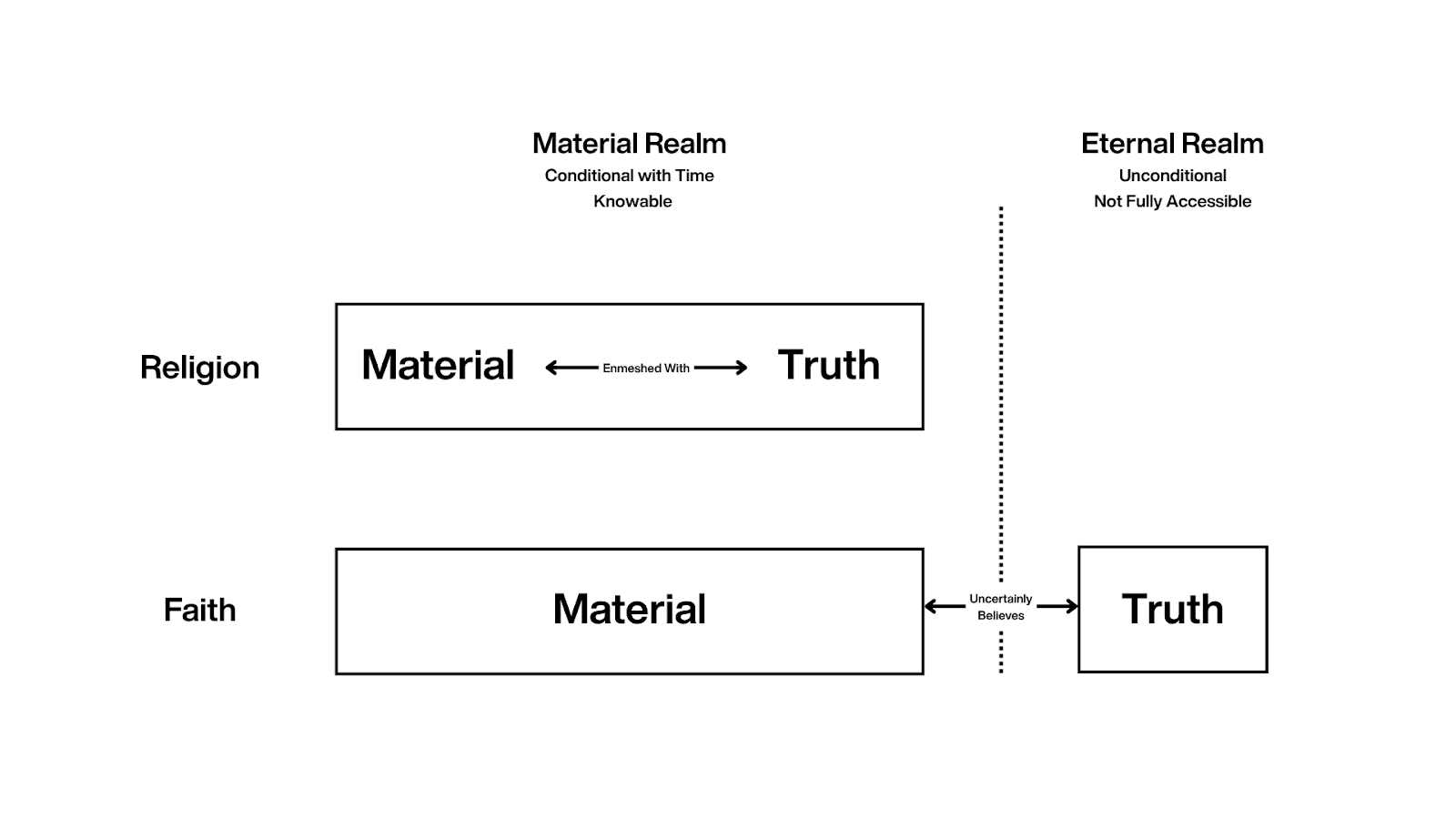
If material religion is the enmeshment of material and truth, the dismantling of religion requires a deliberate separation between them. This separation, a maintained gap, breaks the cycle of certainty and its consequences.
- Material is everything constrained by time, condition, emotion, perception, and change. It is limited and representational.
- Truth is the totality of reality that transcends time and condition. It is holistic, unchanging, and never fully accessible.
Maintaining the gap between materiality and truth produces three essential outcomes:
Humility
Humility arises from the admission that one’s material perspective is limited and cannot represent truth in its fullness. Humility eliminates division, control, and hate by acknowledging limitations.
Faith
Faith is not belief in a doctrine but the posture of engaging reality with uncertainty, the abiding and difficult trust that truth exists beyond the visible and material, while refusing to claim ownership of it. Faith is the bridge maintained by uncertainty, openness, and hope.
Love
Love endures, hopes, and persists precisely because it does not require certainty. Love is the only force that can exist within the gap between material and truth; it does not control or divide but unifies through humility.
Conclusion
Material religion, the association of truth with materiality, is the foundational mechanism driving both the perceived “good” and “evil” in human civilization. Until truth is acknowledged as transcendent beyond material representation, certainty will continue to generate division, hate, bondage, abuse, control, and enslavement. The only solution is the maintained gap: humility over certainty, faith over religion, love over control.
Thanks Delaney for being the answer to so resent prayers. I will at times get images or voices that come to me and it can take a lifetime of patience to make out there meanings sometimes. At times I want to force a meaning upon them rather than allowing YAHAVAH, in his time give me the truth of the meaning. My interpretation of the meaning can become idealism and get me into trouble. I will do my best to follow the following direction. “The only solution is the maintained gap: humility over certainty, faith over religion, love over control.”